
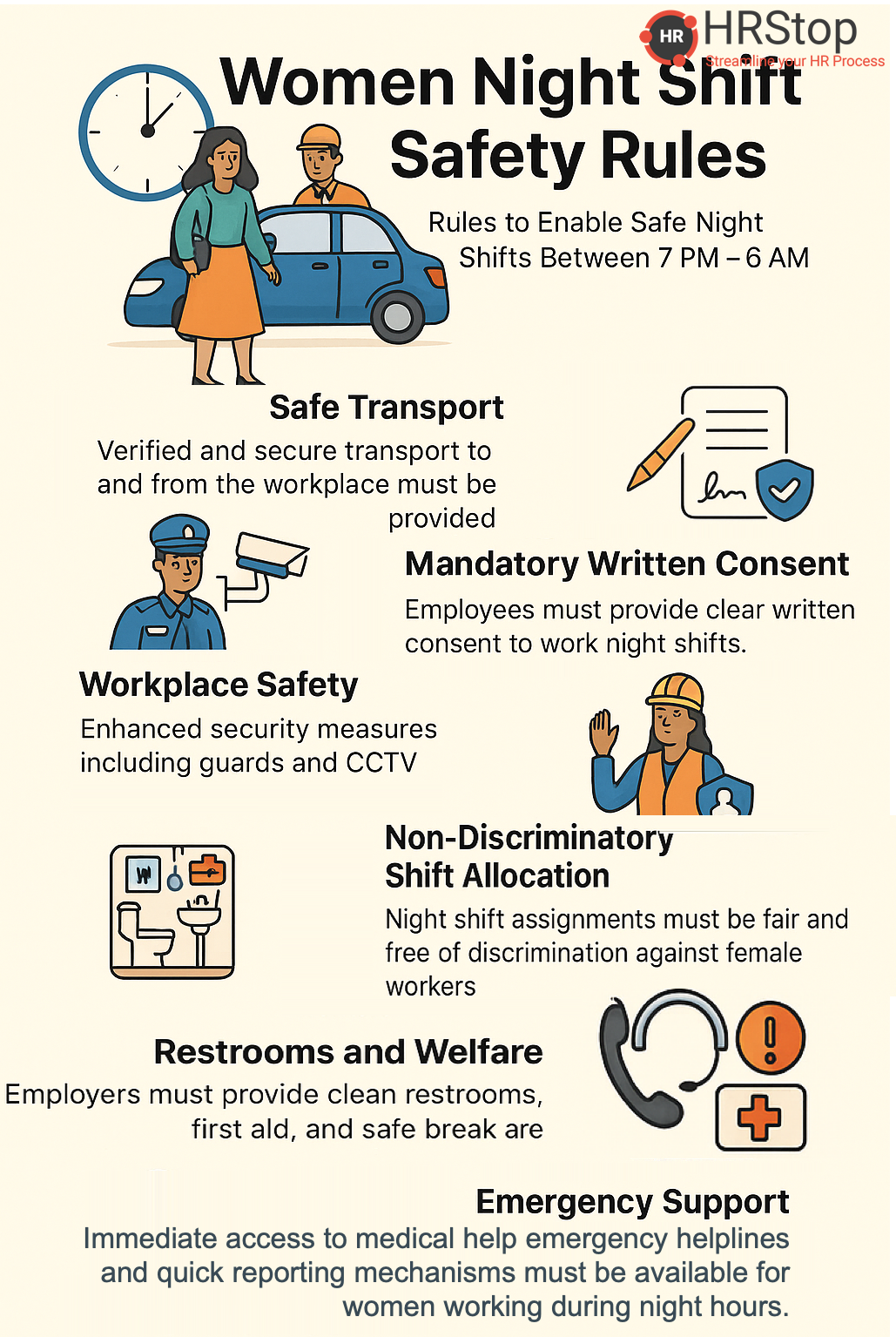
Women Night Shift Safety Rules
The Labour Codes 2025 allow women to work between 7 PM and 6 AM, provided that employers implement strict safety, transport, security, and consent-based measures. This article explains all mandatory requirements so HR teams can confidently enable night shift operations while ensuring full legal compliance and employee safety.
Introduction
Earlier labour laws placed broad restrictions on women working during night hours in many sectors. The new framework under the Occupational Safety and Health Code removes these restrictions but introduces a comprehensive set of safety and operational conditions to ensure women’s protection, dignity, and workplace equality.
Under Labour Codes 2025, women may work night shifts only with written consent and only where employers provide safe transport, adequate workplace security, restrooms, medical support, and non-discriminatory scheduling. The Code also strengthens internal complaint systems, grievance redressal processes, and supervisory vigilance during night hours.
This article gives HR teams a complete picture of requirements so they can update shift policies, SOPs, and safety protocols.
Key Changes at a Glance
- Women can work between 7 PM and 6 AM
- Written consent is mandatory
- Safe transport to and from the workplace
- Mandatory workplace safety measures
- No discrimination in shift allocation
- Additional security for high-risk locations
- Availability of female supervisors where required
- Strengthened grievance redressal mechanisms
Detailed Explanation of Women Night Shift Safety Rules
The points below summarise every major requirement so HR teams can implement night shift policies safely and compliantly.
1. Mandatory Written Consent
Women may work night shifts only if they sign a written consent or a digital consent form.
Consent must be:
- Clear
- Voluntary
- Free from any pressure
HR must maintain digital records of consent for audit purposes.
2. Safe Transport Facilities
Employers must provide:
- Pick-up and drop services
- Safe point-to-point routes
- Verified drivers
- GPS-enabled vehicles
Transport must operate at all times when women are present during night hours.
3. Adequate Workplace Security
Security arrangements must include:
- Trained security personnel
- CCTV coverage of entry and exit points
- Well-lit premises
- Controlled access
High-risk workplaces may require additional protocols such as panic buttons or monitored access.
4. Non-Discriminatory Shift Allocation
Women must not be:
- Compelled to work nights
- Penalised for refusing night shifts
- Given fewer opportunities or shifts due to gender
Shift planning must ensure equal opportunity and fair distribution.
5. Availability of Women Supervisors
Where the nature of work requires supervision, employers must ensure female supervisors or adequate female representation in supervisory teams during night hours.
6. Restrooms and Welfare Facilities
Employers must provide:
- Clean and separate restrooms
- Well-lit break areas
- Safe waiting spaces
- Drinking water and first aid facilities
These are mandatory under the OSH Code.
7. Emergency and Medical Support
Organisations must ensure access to:
- On-call medical support
- Emergency helplines
- Quick reporting channels
- Incident response plans
This protects women working late hours from medical or safety emergencies.
8. Strengthened Grievance Redressal
Internal Complaints Committee (ICC) must be accessible for night shift employees.
Policies must clearly explain:
- Reporting channels
- Escalation timelines
- Support processes
For broader OSH safety context, you may read Occupational Safety and Health Code Explained.
9. HR and Managerial Responsibilities
HR teams must:
- Maintain consent records
- Ensure transport schedules align with shift timings
- Review security arrangements frequently
- Conduct periodic safety audits
- Train managers on women safety requirements
For working hour details, refer to Working Hours Leave and Overtime Rules.
Women Night Shift Regulations
| Category | Earlier Provisions | New Provisions Under Labour Codes 2025 |
|---|---|---|
| Night Shift Permission | Mostly restricted | Fully permitted with consent |
| Transport Requirement | Not uniform | Mandatory safe transport |
| Security Standards | Basic requirements | Detailed safety and security measures |
| Supervisors | Not clearly defined | Adequate female supervision required |
| Grievance Support | Varies | Strengthened ICC and reporting channels |
| Workplace Facilities | Limited requirements | Mandatory welfare facilities |
| Non-Discrimination | Not specified | Explicitly mandated |
HR Checklist for Immediate Action for Women Night Shift Compliance
- Create written consent workflows
- Arrange verified and secure transport
- Conduct workplace safety audits
- Update night shift policies and SOPs
- Ensure presence of female supervisors where required
- Strengthen ICC visibility and accessibility for night shift staff
- Document all compliance measures digitally
- Train employees and managers on night shift safety rules
Explore HRStop Today
HRStop helps organisations manage night shift compliance with digital consent workflows, transport assignment logs, safety documentation, grievance tracking, and shift-based compliance alerts.
How HRStop Helps
- Digital consent capture for night shifts
- Automated transport and shift records
- Safety and incident reporting workflows
- ICC documentation and grievance systems
- Multi location compliance dashboards
- Attendance and shift analytics
Related Articles
- Working Hours Leave and Overtime Rules
- Inter State Migrant Worker Provisions
- Occupational Safety and Health Code Explained
- India’s New Labour Codes 2025 Overview
Conclusion
The Labour Codes 2025 provide women with greater flexibility and employment opportunities by allowing night shift work with mandatory safety measures. These rules enhance workplace equality while ensuring physical security, mental well being, and fair treatment. HR teams must update shift policies, transport systems, SOPs, and safety audits to ensure full compliance.
FAQs
Can women work night shifts under the Labour Codes 2025
Yes with written consent and mandatory safety measures.
Is transport mandatory
Yes employers must provide safe and verified transport.
Do women supervisors need to be present
Where required by job nature, yes.
Can women refuse night shifts
Yes without facing discrimination or penalty.
Does this apply to IT and office based roles
Yes it applies to all notified establishments.
Rashmi Agarwal
Tuesday, November 25, 2025
Share post:
Become part of our team
- Full Stack Developer
- Business Development Executive
- Technical Content Writer
- HR Business Partner
- Customer Happiness Executive
- Marketing Executive
One stop solution for all
Hire to Retire needs
HRStop is a complete Hire to Retire HR platform that accelerates the success of your business processes.