
Vacancy Reporting Guidelines
The Labour Codes 2025 require employers to report vacancies to notified career centres within a specified timeline. This ensures transparent labour market information and helps workers access job opportunities nationwide. This article explains reporting rules, timelines, formats, and HR responsibilities.
Introduction
Vacancy reporting has existed in earlier laws but was applied inconsistently and often limited to specific establishments. Under the Labour Codes 2025, the requirement becomes broader and more structured. Employers must now report all notified vacancies to designated career centres using the prescribed digital format.
This framework promotes equal employment opportunities, improves labour matching efficiency, and supports government workforce planning. For HR teams, vacancy reporting is now a defined compliance function with clear timelines and procedures that must be integrated into recruitment workflows.
This article provides a complete explanation of the vacancy reporting obligations and the actions HR teams must take to stay compliant.
Key Changes at a Glance
- Mandatory reporting of vacancies to career centres
- Digital reporting format prescribed
- Timelines defined for all establishments
- Applies to permanent and fixed term roles
- Exemptions available only for certain categories
- Enables nationwide labour market visibility
- Supports workforce planning efforts
Detailed Explanation of Vacancy Reporting Guidelines
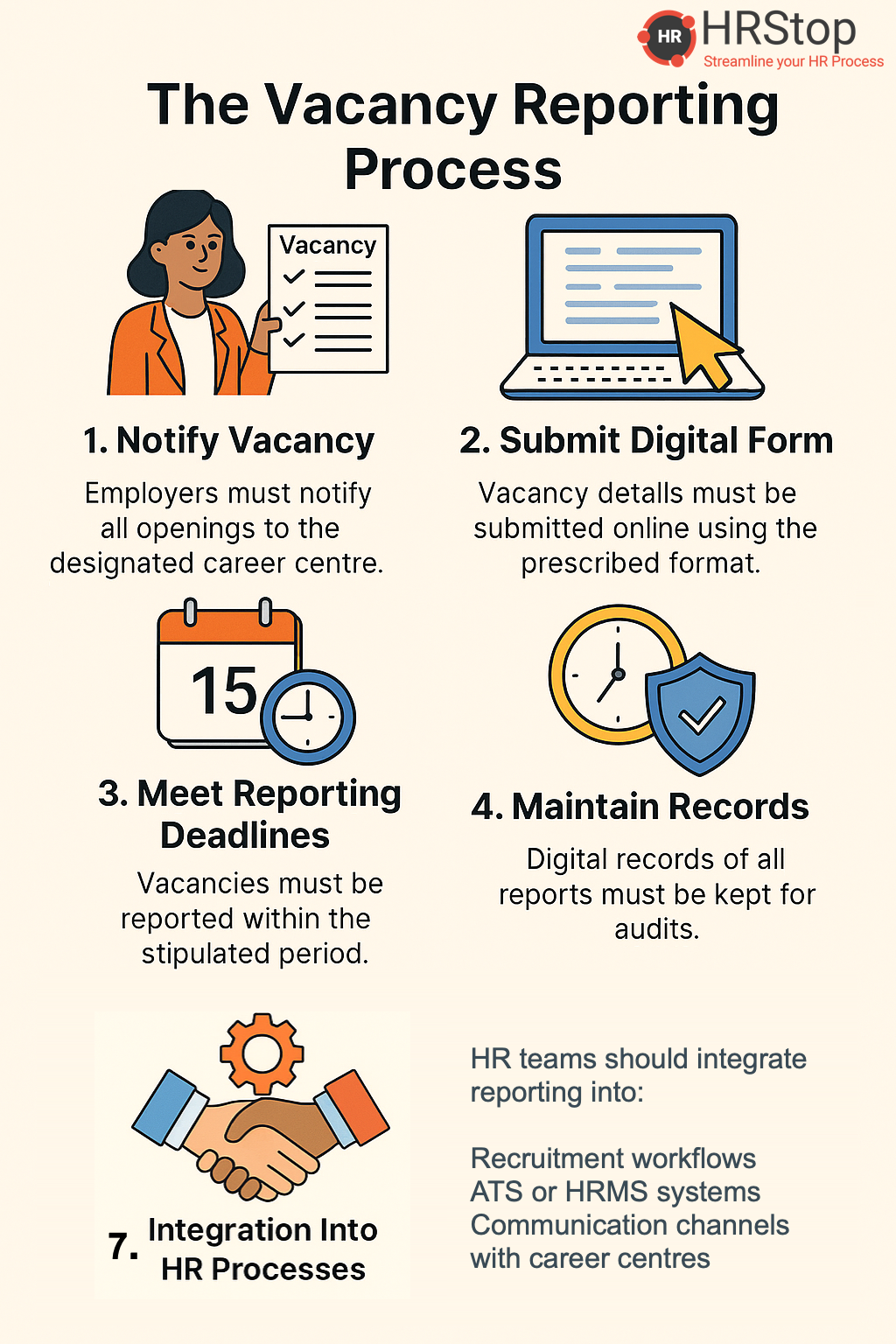
1. Mandatory Reporting to Career Centres
Employers must report all vacancies notified under the Code to the appropriate career centre.
This applies to:
- Permanent roles
- Fixed term employment
- Skilled and semi-skilled positions
Routine internal promotions or role changes are generally exempt.
2. Format and Mode of Submission
Vacancy details must be submitted in the prescribed digital format including:
- Job title
- Job description
- Required skills
- Number of positions
- Salary range
- Location
- Application timeline
Digital reporting ensures uniformity and transparency.
3. Reporting Timeline
Vacancies must be reported within the stipulated days from the date the vacancy arises.
This ensures the labour department has real-time visibility of job openings.
4. Exemptions
Certain roles may not require reporting such as:
- Confidential positions
- Senior management in some sectors
- Short-term project-based roles (subject to notification)
HR must verify exemption status before deciding not to report.
5. Benefits of Vacancy Reporting
Vacancy reporting helps:
- Improve job visibility for workers
- Reduce hiring timelines
- Support government employment programs
- Enable data-driven workforce planning
For broader social security and worker access context, read Social Security Code Explained.
6. Integration Into HR Processes
HR teams should integrate reporting into:
- Recruitment workflows
- ATS or HRMS systems
- Communication channels with career centres
Digitisation makes it easier to align reporting with hiring.
7. Compliance and Audit Requirements
HR must maintain digital records of:
- Reported vacancies
- Submission receipts
- Correspondence with career centres
These may be reviewed during digital inspections.
For inspection specifics see Digital Inspections Under New Labour Codes.
Vacancy Reporting Framework
| Category | Earlier System | New System Under Labour Codes 2025 |
|---|---|---|
| Reporting Requirement | Limited and inconsistent | Mandatory for notified vacancies |
| Mode of Reporting | Manual/physical | Digital submission |
| Timelines | Not clearly defined | Specific timelines prescribed |
| Coverage | Some establishments only | Broader coverage including fixed term roles |
| Recordkeeping | Paper-based | Digital records mandatory |
| Transparency | Low | Increased job visibility |
HR Checklist for Immediate Action for Vacancy Reporting Compliance
- Identify roles requiring mandatory reporting
- Set up digital reporting process with career centres
- Define internal timelines aligned with the Code
- Integrate vacancy reporting into recruitment workflows
- Train HR teams and hiring managers
- Maintain digital records of all submissions
- Audit reporting compliance monthly
Explore HRStop Today
HRStop enables seamless vacancy reporting with digital job postings pre-filled templates automated recordkeeping and compliance alerts built into your recruitment workflow.
How HRStop Helps
- Auto-generated vacancy reporting templates
- Digital submission records
- Integrated recruitment and compliance workflows
- Multi-location vacancy tracking
- Cloud storage for reporting documents
Related Articles
- Social Security Code Explained
- Digital Inspections Under New Labour Codes
- Single Registration License and Return System
- India’s New Labour Codes 2025 Overview
Conclusion
Vacancy reporting under the Labour Codes 2025 is a key compliance requirement aimed at improving employment transparency and labour market efficiency. HR teams must digitalise their reporting processes and align internal hiring workflows with the new guidelines to remain compliant.
FAQs
Are all vacancies required to be reported?
Only vacancies notified under the Code need to be reported.
Is digital submission mandatory?
Yes, digital reporting is required under the new system.
Do fixed term vacancies need reporting?
Yes, unless specifically exempted.
Are short-term project roles exempt?
Some may be, based on notifications.
Do we need to maintain submission records?
Yes, digital records must be stored for audit purposes.
Rashmi Agarwal
Tuesday, November 25, 2025
Share post:
Become part of our team
- Full Stack Developer
- Business Development Executive
- Technical Content Writer
- HR Business Partner
- Customer Happiness Executive
- Marketing Executive
One stop solution for all
Hire to Retire needs
HRStop is a complete Hire to Retire HR platform that accelerates the success of your business processes.