
Sector Wise Comparison Table Under New Labour Codes
The Labour Codes 2025 impact every major sector differently based on working hours, safety rules, wage structure, compliance requirements, and social security obligations. This article provides a simplified sector wise comparison to help HR teams quickly understand what has changed across fifteen industries.
Introduction
The Labour Codes replace numerous sector specific Acts with four unified Codes. However, their practical impact differs across industries depending on workforce size, risk category, skill level, mobility, shift structure, and contractual engagement practices.
This article presents a consolidated sector wise comparison covering manufacturing, IT, retail, logistics, gig platforms, construction, export units, and more. It highlights how working hours, wages, safety norms, digitisation requirements, and social security provisions affect each sector differently.
HR teams can use this table to benchmark readiness, design compliance strategies, and plan industry specific implementation.
Key Changes at a Glance
- Uniform wage definition across all sectors
- Universal eight hour working day and forty eight hour week
- Mandatory digital registers and online returns
- Wider PF and ESIC applicability
- Night shift rules for women applicable across sectors
- Stronger safety standards for high risk industries
- Mandatory registration and documentation of migrant and contract workers
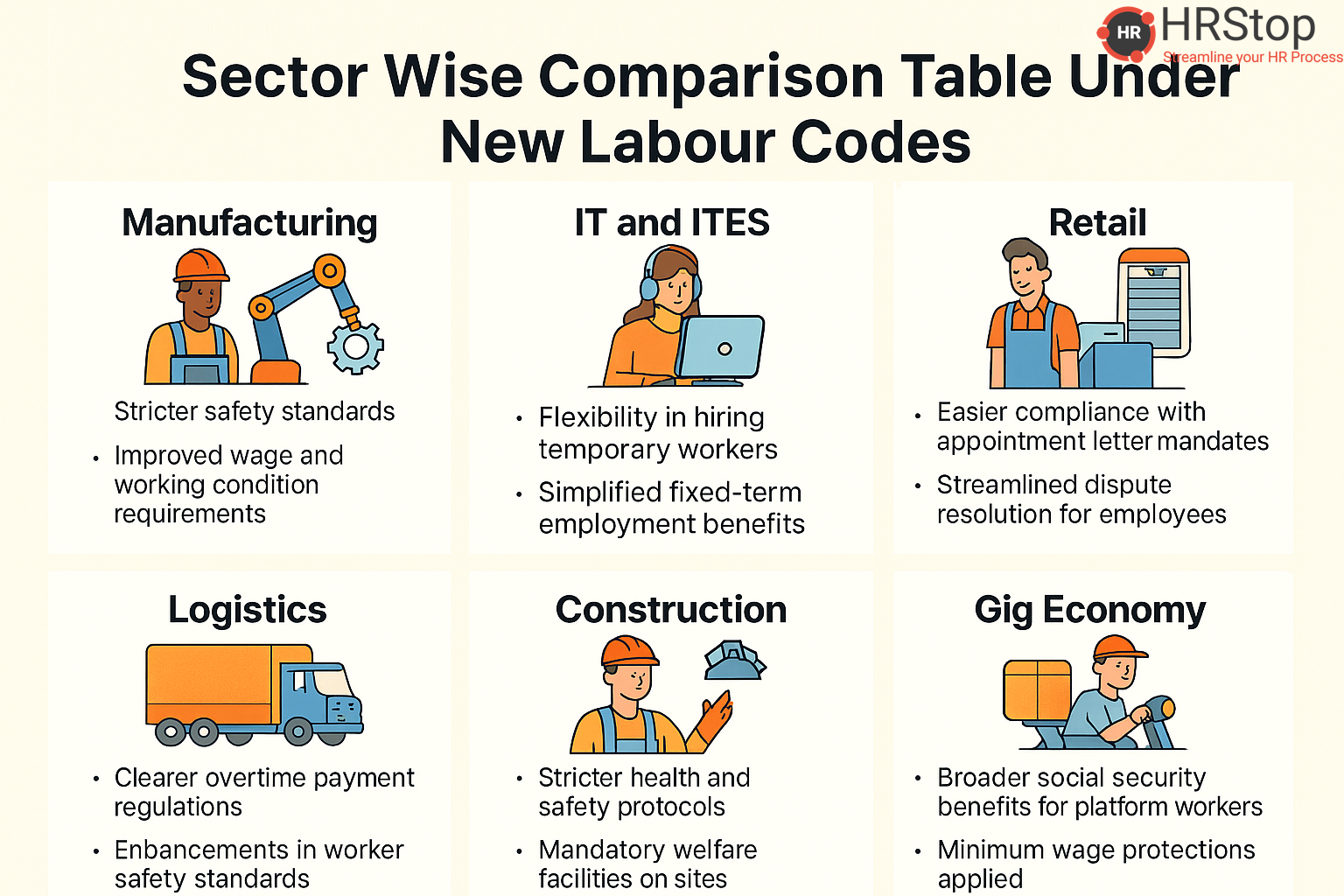
Detailed Sector Wise Comparison Under Labour Codes 2025
The table below summarises earlier practices versus new requirements for major industries.
| Sector | Earlier Rules | New Labour Code Requirements |
|---|---|---|
| Manufacturing | Different working hour rules, manual registers, varied safety standards | Uniform eight hour day, digital registers, mandatory safety and health provisions under OSH Code |
| IT and ITES | Flexible hours with limited inspection oversight | Clear rules on working hours, digital compliance, women night shift consent and safety norms |
| Retail and Shops | State wise shop and establishment laws, varying leave and hour norms | Unified working hour limits, weekly rest, digital records, wider social security coverage |
| Logistics and Warehousing | Varied contractor rules, limited safety audits | Mandatory contractor compliance, digital attendance, safety and welfare checks |
| Construction | Sector specific welfare laws, manual worker records | Digital registration of migrant workers, portable benefits, safety norms under OSH Code |
| Gig and Platform Economy | No defined social security rules | Mandatory aggregator contribution and platform worker coverage under Social Security Code |
| Hospitality and Food Services | Varied shift norms, inconsistent leave rules | Uniform working hours, digital registers, women night shift provisions applicable |
| Export Units and SEZs | Special allowances but fragmented rules | Unified wage definition, digital compliance, safety standards aligned with OSH Code |
| Healthcare Services | Long shift hours with relaxed rules | Standardised working hours with exemptions only if notified, safety audits mandated |
| E-commerce | Heavy reliance on gig-like workforce, varied contractor systems | Digital records, contractor accountability, equal safety and wage rules |
| Education Sector | State based rules, varied leave norms | Standardised wage components, working hour clarity, digital recordkeeping |
| Mining and Heavy Industries | Stronger older laws but manual processes | Updated hazardous process norms, mandatory safety audits, digital inspection |
| Transportation | Varied hours by state and category | Standardised working hours and overtime rules, safety compliance for drivers |
| MSMEs | Limited compliance due to thresholds | Single registration, simplified digital compliance, broader applicability of PF and ESIC |
| Startups | Flexible systems but poor documentation | Mandatory digital records, clearly defined employment terms, wage structure compliance |
HR Checklist for Immediate Action for Sector Wise Labour Code Readiness
- Identify sector specific high impact areas
- Update policies on working hours and weekly rest
- Ensure uniform wage structure as per Code requirements
- Digitalise all registers and worker records
- Strengthen contractor and migrant worker documentation
- Assess industry specific safety and OSH requirements
- Train managers on sector wise Code implications
Explore HRStop Today
HRStop supports sector wise compliance with digital registers, unified wage structures, contractor dashboards, automated returns, and multi location monitoring tools that align with Labour Codes 2025.
How HRStop Helps
- Industry specific compliance checklists
- Digital registers and single return workflows
- Contractor and gig workforce documentation
- OSH compliance monitoring
- Multi location dashboards for sector operations
Related Articles
- Social Security Code Explained
- Working Hours Leave and Overtime Rules
- Updated Contract Labour Rules
- Digital Compliance and Online Records
- India’s New Labour Codes 2025 Overview
Conclusion
The Labour Codes 2025 harmonise compliance across India while introducing industry specific operational impacts. HR teams must understand these sector wise differences to implement accurate policies, manage workforce expectations, and ensure smooth compliance.
FAQs
Do the Labour Codes apply uniformly to all sectors?
The Codes are uniform, but their effects vary depending on industry risk levels and workforce structure.
Are working hours the same across sectors?
Yes, except for notified special categories.
Do gig workers get social security?
Yes, aggregators must contribute under the Social Security Code.
Do contractors need digital registers?
Yes, for all sectors engaging contract labour.
Is safety compliance mandatory in low risk sectors?
Yes, all sectors must meet basic OSH standards.
Rashmi Agarwal
Tuesday, November 25, 2025
Share post:
Become part of our team
- Full Stack Developer
- Business Development Executive
- Technical Content Writer
- HR Business Partner
- Customer Happiness Executive
- Marketing Executive
One stop solution for all
Hire to Retire needs
HRStop is a complete Hire to Retire HR platform that accelerates the success of your business processes.