
Penalties and Risks Under UAE Minimum Wage
The UAE minimum wage requirement for Emirati employees is supported by enforcement mechanisms designed to ensure compliance across the private sector.
While the regulation focuses on fair compensation, non-compliance can expose employers to operational, regulatory, and Emiratisation-related risks. Understanding these risks early helps organisations avoid disruption.
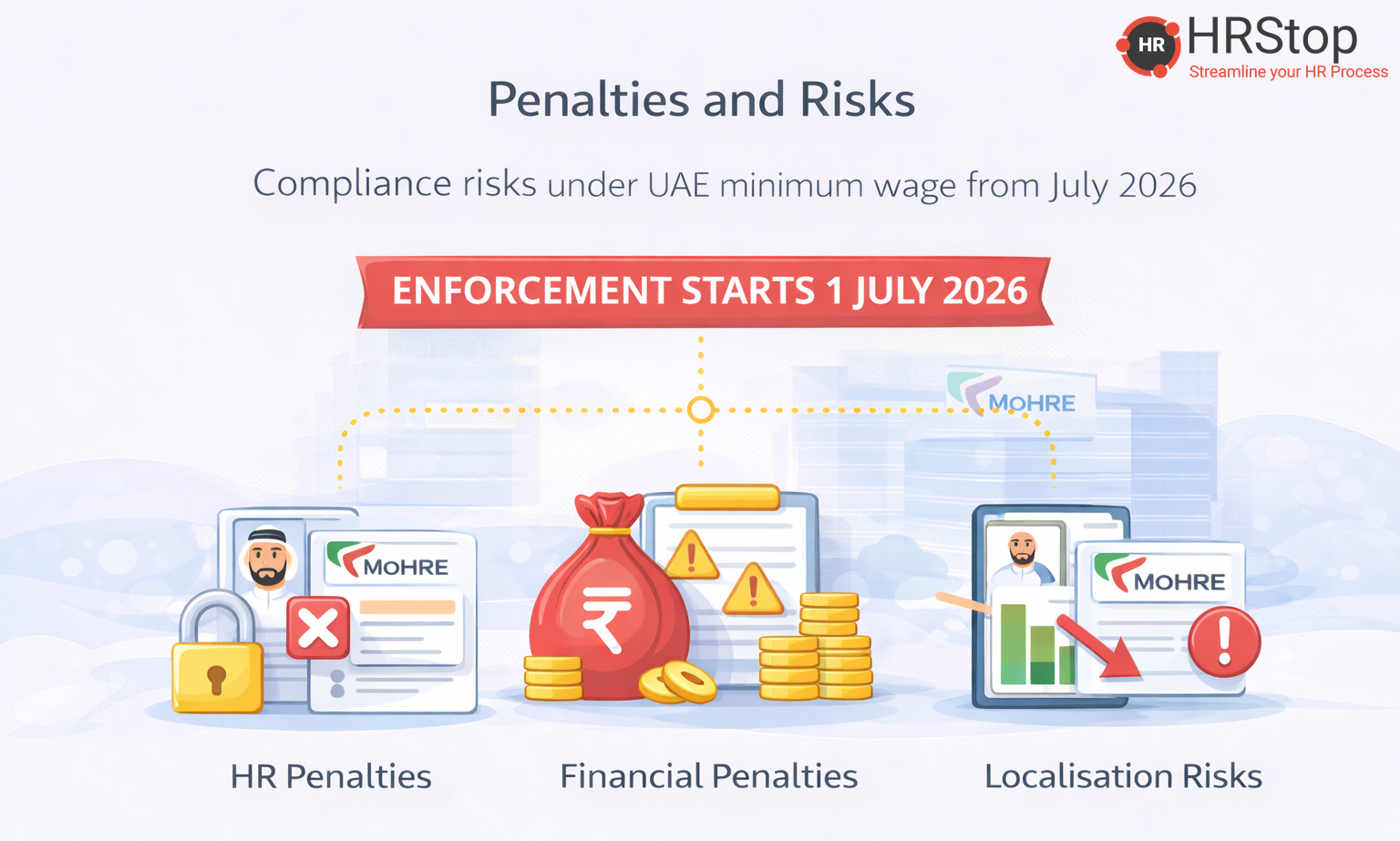
Enforcement Timeline
MoHRE has outlined a clear enforcement approach.
- From 1 January 2026, the minimum wage requirement becomes effective
- Between January and June 2026, employers are expected to correct salaries where required
- From 1 July 2026, enforcement actions may apply for non-compliant establishments
Employers are advised to use the transition period proactively rather than waiting for permit transactions to surface issues.
Work Permit Restrictions
One of the most immediate risks of non-compliance is related to work permits.
Employers may face:
- Rejection of new Emirati work permit applications
- Inability to renew existing permits
- Delays in permit modifications
These restrictions can directly affect hiring continuity and workforce planning.
This is closely linked to
Work Permits and Renewals
Impact on Emiratisation Calculations
Salary non-compliance can result in:
- Emirati employees being excluded from Emiratisation counts
- Reduced localisation scores
- Increased pressure to hire additional Emirati employees
This can create a compounding compliance issue where wage gaps lead to Emiratisation shortfalls.
Related context is covered in
Emiratisation Impact
Operational and Business Risks
Beyond regulatory actions, employers may face:
- Delays in onboarding Emirati hires
- Increased administrative workload
- Reactive payroll corrections under time pressure
- Reputational risk during audits or inspections
These risks are often indirect but can significantly affect HR operations.
Common Compliance Gaps
HR teams frequently encounter issues such as:
- Mismatch between payroll data and MoHRE records
- Delayed salary updates during permit renewals
- Lack of visibility across entities or locations
- Manual tracking of compliance milestones
Addressing these gaps early reduces the likelihood of enforcement actions.
HR Checklist for Risk Mitigation
- Identify Emirati employees below the minimum wage threshold
- Validate salary data in MoHRE systems
- Align payroll and HR records consistently
- Track permit renewal and modification timelines
- Document corrective actions for audit readiness
FAQs
When do penalties start applying
Enforcement actions may apply from 1 July 2026 for non-compliant employers.
Can employers still hire Emiratis if salaries are non-compliant
No. Permit issuance and renewals may be blocked until salary compliance is ensured.
Does non-compliance affect Emiratisation scores
Yes. Non-compliant employees may be excluded from localisation calculations.
Are penalties financial or operational
Current guidance indicates operational restrictions rather than direct fines.
Related Articles
- UAE Minimum Wage 2026
- Who Does It Apply To
- Payroll Impact Explained for UAE Minimum Wage
- Work Permits and Renewals
- Emiratisation Impact
- HR Systems Readiness
🎯 HRStop helps organisations reduce compliance risk by providing structured visibility into employee data, salary alignment, work permits, and Emiratisation metrics. This enables HR teams to move from reactive corrections to proactive compliance management Request a Free HR Process Audit
# Compliance
# Payroll
# Payroll Compliance
#2026
#UAE Minimum Wage
#MoHRE Compliance
#UAE Labour Law
#Emiratisation
Rashmi Agarwal
Wednesday, January 21, 2026
Share post:
Become part of our team
- Full Stack Developer
- Business Development Executive
- Technical Content Writer
- HR Business Partner
- Customer Happiness Executive
- Marketing Executive
One stop solution for all
Hire to Retire needs
HRStop is a complete Hire to Retire HR platform that accelerates the success of your business processes.