
Industrial Relations Code Explained
The Industrial Relations Code establishes a modern framework for maintaining workplace harmony supporting fair employment practices and simplifying compliance for employers and HR teams across India. It merges earlier laws related to trade unions standing orders layoffs retrenchment and dispute resolution into a unified structure that supports both employee rights and organisational needs. This article explains the key provisions in simple clear language to help HR professionals prepare for Labour Codes 2025.
Introduction
The Industrial Relations Code is one of the most important reforms among the Labour Codes 2025 because it directly influences how organisations hire manage and separate employees. It merges the Trade Unions Act the Industrial Employment Standing Orders Act and the Industrial Disputes Act into one integrated Code. This structure removes inconsistencies found earlier and helps organisations maintain predictable and transparent employment practices.
For HR teams the Industrial Relations Code introduces new rules related to trade union recognition strike procedures standing orders retrenchment thresholds grievance redressal and dispute settlement mechanisms. Organisations will need to update policies documentation and internal processes to remain fully compliant. This article offers a simple practical breakdown of these changes so HR professionals can implement them confidently and ensure smooth employer employee relations.
Key Changes at a Glance
- Single consolidated framework for trade unions standing orders and dispute resolution
- Clear rules for negotiating unions
- New threshold for standing orders
- Revised process for layoffs retrenchment and closure
- Defined notice period and procedures for strikes
- Establishment of grievance redressal committees
- Simplified dispute resolution through tribunals
- Emphasis on transparency and fairness in employment practices
Detailed Explanation of the Industrial Relations Code
The sections below summarise the major provisions of the Industrial Relations Code and highlight what HR professionals must understand to maintain compliant and harmonious workplaces.
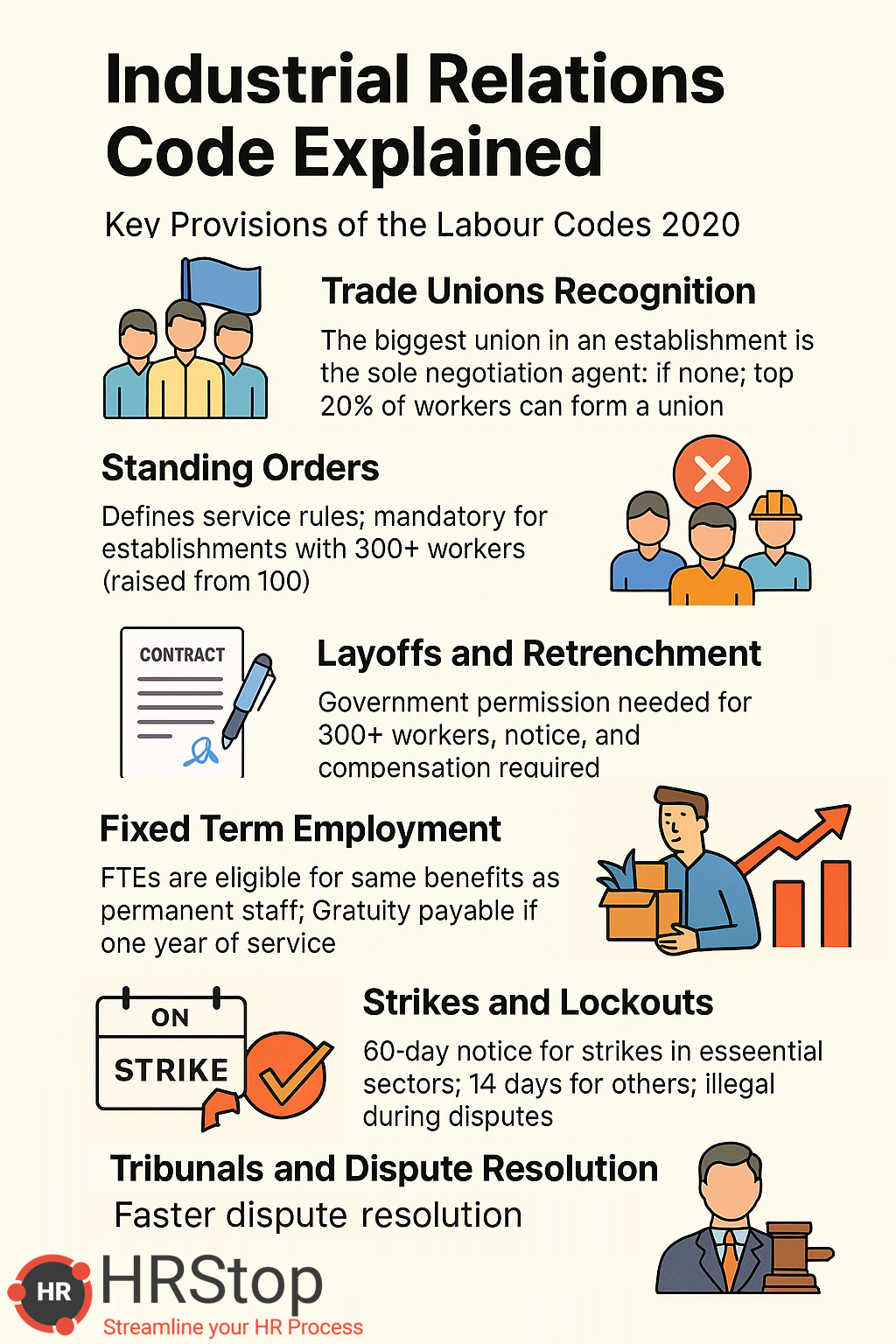
1. Trade Unions and Negotiating Union Rules
The Code introduces a clear and structured method for recognising the negotiating union or negotiating council.
A union with at least fifty one percent membership becomes the negotiating union.
If no single union meets this level a negotiating council is formed with representatives from multiple unions.
This brings transparency and prevents disputes related to representation.
2. Standing Orders and Applicability Threshold
Under the earlier law standing orders applied to establishments with one hundred or more employees.
The Industrial Relations Code increases this threshold to three hundred employees.
Organisations meeting this threshold must define clear rules relating to classification of workers attendance discipline holidays and termination procedures.
Model standing orders may also be notified by the government reducing administrative burden for employers.
3. Reskilling Fund Requirement
The Code introduces a reskilling fund to support workers who are retrenched.
Employers must contribute an amount equal to fifteen days wages for every retrenched worker.
This amount is transferred directly to the worker to aid their transition.
This provision helps employees manage the financial impact of job loss.
4. Layoffs Retrenchment and Closure
The threshold for government permission for layoffs retrenchment and closure has also been raised to three hundred workers.
This supports operational flexibility for establishments while maintaining necessary protection for workers.
Notice requirements compensation and timelines remain clearly defined ensuring fair treatment of employees.
5. Strikes and Lockouts
The Code introduces a defined procedure for strikes including mandatory notice requirements.
Workers must provide notice at least fourteen days before going on strike.
Strikes are prohibited during the pendency of conciliation proceedings and during tribunal hearings.
This prevents sudden disruptions and promotes structured conflict resolution.
6. Grievance Redressal Committee
Every establishment with twenty or more workers must set up a grievance redressal committee.
This committee must include adequate representation of women and provide a timely mechanism for resolving employee concerns internally before they escalate to disputes.
7. Industrial Tribunals and Dispute Resolution
The Code introduces two member tribunals for faster dispute settlement.
These tribunals improve efficiency transparency and reliability in resolving employment disputes.
To understand the broader compliance framework you may also read the article India’s New Labour Codes 2025 Overview.
HR Checklist for Immediate Action for Industrial Relations Code Compliance
- Review trade union recognition processes
- Identify applicability of standing orders based on workforce size
- Prepare or update standing orders to meet new requirements
- Establish a grievance redressal committee if not already present
- Review internal processes for layoffs retrenchment and closure
- Create documentation for strike intimation procedures
- Train HR and managers on new dispute resolution practices
- Ensure communication channels with employee representatives are structured and active
Explore HRStop Today
HRStop supports compliance with the Industrial Relations Code by providing digital workflows for managing standing orders dispute records notices and employee communication. It ensures transparency consistent documentation and timely action for all Industrial Relations Code requirements.
How HRStop Helps
- Digital standing order documentation and updates
- Grievance redressal committee workflows
- Automated reminders for compliance timelines
- Centralised communication logs with unions and employee groups
- Digital notice management for strikes and retrenchment
- Structured dispute documentation and tribunal ready records
Related Articles
- Fixed Term Employment Rules
- Updated Contract Labour Rules
- Working Hours Leave and Overtime Rules
- Social Security Code Explained
- Digital Inspections Under New Labour Codes
- India’s New Labour Codes 2025 Overview
Conclusion
The Industrial Relations Code creates a modern balanced and structured framework that supports employee rights while enabling organisations to operate with clarity and predictability. By simplifying union recognition revising standing order thresholds defining fair procedures for layoffs and enhancing dispute resolution mechanisms the Code promotes workplace harmony. HR teams play a crucial role in implementing these reforms and ensuring transparent and compliant employee relations under the Labour Codes 2025.
FAQs
Does the Industrial Relations Code replace earlier labour laws
Yes it consolidates three earlier laws into one unified Code.
What is the negotiating union
A union with fifty one percent membership which becomes the primary representative body for negotiations.
What is the new threshold for standing orders
Standing orders now apply to establishments with three hundred or more workers.
Do strikes require notice
Yes fourteen days notice is mandatory before going on strike.
What is the reskilling fund
Employers must contribute fifteen days wages for every retrenched worker to support their transition.
Are grievance redressal committees mandatory
Yes organisations with twenty or more workers must establish one.
How do tribunals help
They ensure faster and more transparent resolution of industrial disputes.
Rashmi Agarwal
Tuesday, November 25, 2025
Share post:
Become part of our team
- Full Stack Developer
- Business Development Executive
- Technical Content Writer
- HR Business Partner
- Customer Happiness Executive
- Marketing Executive
One stop solution for all
Hire to Retire needs
HRStop is a complete Hire to Retire HR platform that accelerates the success of your business processes.