
Fixed Term Employment Rules
The Industrial Relations Code introduces a clear framework for Fixed Term Employment ensuring that workers hired for a specific project or duration receive the same wages and benefits as permanent employees. Fixed Term Employment brings flexibility for employers while protecting workers from unequal treatment. This article explains the rules in simple practical terms to help HR teams prepare for Labour Codes 2025.
Introduction
Fixed Term Employment is one of the most progressive provisions under the new Labour Codes. It provides organisations with the ability to hire workers for a defined period without relying on contractors while ensuring that employees hired on this basis are treated fairly and receive all statutory benefits. The Industrial Relations Code establishes uniform rules for Fixed Term Employment across all industries eliminating ambiguity and preventing misuse.
For HR teams these rules influence salary structure benefit calculations manpower planning appointment letters and exit processes. The Code requires that employers extend the same benefits to Fixed Term workers as they do to permanent employees including gratuity eligibility after one year of service. The following sections offer a detailed overview of the rules and their practical implications under Labour Codes 2025.
Key Changes at a Glance
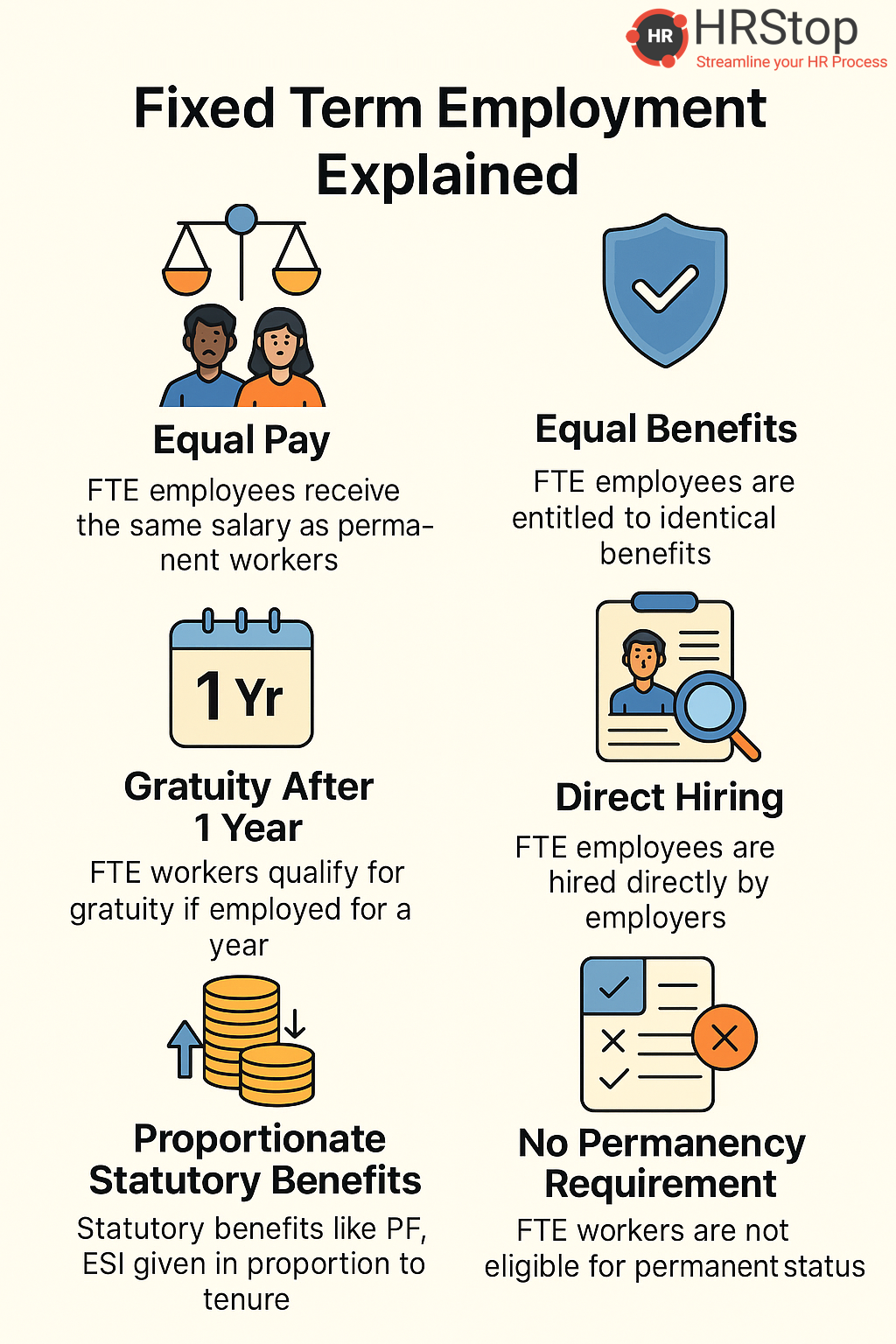
- Fixed Term Employment allowed across all sectors
- FTE workers must receive same pay and benefits as permanent staff
- Gratuity is payable after one year of service
- No requirement to convert FTE workers into permanent roles
- Employers may hire directly without contractors
- All statutory benefits based on tenure and eligibility
- Appointment letters must clearly specify contract duration
Detailed Explanation of Fixed Term Employment Rules
The points below break down the major provisions of Fixed Term Employment so HR teams can design compliant contracts and ensure fair treatment of FTE workers.
1. Equal Pay and Benefits for FTE Workers
FTE employees must receive wages allowances and benefits equal to those provided to permanent workers performing the same or similar work. This includes statutory benefits where eligibility conditions are met. The intention is to prevent discrimination based solely on contract duration.
This protects workers while giving employers flexibility to scale teams based on project needs.
2. Gratuity Eligibility After One Year
One of the most important reforms is that Fixed Term workers become eligible for gratuity if they complete one year of continuous service. Permanent employees remain eligible after five years.
This supports social security for employees who work on defined term projects which were earlier excluded from such benefits.
3. No Mandatory Permanency Requirements
Employers are not required to offer permanent employment once the contract period ends. The contract naturally terminates after the specified period without any additional obligations unless an extension or renewal is mutually agreed.
This gives employers workforce flexibility while ensuring clear expectations for workers.
4. Freedom to Hire Directly Without Contractors
Organisations may hire Fixed Term employees directly without engaging labour contractors. This helps reduce compliance complexity and improves transparency in wages benefits and working conditions.
It also brings clarity since the relationship is directly between employer and worker.
5. Proportionate Statutory Benefits
Fixed Term workers are entitled to statutory benefits such as leave contributions and allowances on a proportionate basis. Contribution based schemes like PF and ESIC apply based on eligibility similar to permanent employees.
This ensures that workers engaged for shorter durations still receive fair benefits.
6. Clear Appointment Letter Requirements
Appointment letters for Fixed Term roles must clearly mention the:
- Duration of employment
- Wages and allowances
- Working hours
- Benefits applicable
- Conditions for renewal or non renewal
Having these details documented supports fair treatment and protects employers and employees from disputes.
7. Practical Impact on Employers
Fixed Term Employment helps organisations manage seasonal peaks project based staffing and specialised roles without long term commitments. It reduces dependence on contractors while improving transparency in wage and benefit practices.
To understand related employment compliance rules you may also read Industrial Relations Code Explained.
HR Checklist for Immediate Action for Fixed Term Employment Compliance
- Prepare updated FTE appointment letters with contract duration and benefits
- Ensure equal wages and benefits for FTE and permanent workers performing similar roles
- Review gratuity calculations for FTE workers completing one year
- Configure payroll to apply statutory benefits proportionately
- Document renewal and non renewal practices clearly
- Train managers on correct FTE hiring and separation procedures
- Verify workforce plans to ensure accurate use of FTE roles
- Maintain digital records for all contract periods and extensions
Explore HRStop Today
HRStop supports complete compliance with Fixed Term Employment rules by generating contract ready appointment letters managing benefit calculations and maintaining accurate digital records for each FTE worker. It helps HR teams streamline workforce planning while ensuring full compliance with Labour Codes 2025.
How HRStop Helps
- Prebuilt FTE appointment letter templates
- Automated benefit calculations including gratuity eligibility
- Payroll configuration for proportionate statutory benefits
- Digital tracking of contract start and end dates
- Renewal alerts and contract documentation
- Unified dashboard for permanent and FTE workforce compliance
Related Articles
- Industrial Relations Code Explained
- Gratuity Rules for FTE Employees
- Social Security Code Explained
- Impact of Labour Codes on Key Industries
- India’s New Labour Codes 2025 Overview
Conclusion
Fixed Term Employment brings balanced flexibility to India’s labour landscape. It allows organisations to hire for specific durations or projects while ensuring workers receive equal wages benefits and fair treatment. With clear rules for benefits gratuity eligibility and contract documentation the Industrial Relations Code makes Fixed Term Employment structured and transparent. HR teams play an essential role in designing compliant FTE processes and ensuring readiness for Labour Codes 2025.
FAQs
Does Fixed Term Employment require conversion to permanent roles
No the contract ends naturally on completion of the specified term unless renewed.
Are FTE workers eligible for gratuity
Yes they become eligible if they complete one year of continuous service.
Do FTE workers receive equal benefits
Yes they must receive wages and benefits equal to permanent workers performing similar work.
Can FTE workers be hired directly
Yes employers can hire FTE workers directly without contractors.
Do statutory benefits apply proportionately
Yes benefits such as PF ESIC and leave apply based on eligibility and duration of service.
Is renewal mandatory after contract end
No renewal is entirely at the discretion of the employer and employee.
What documents must be included in FTE appointment letters
Contract duration pay benefits working hours renewal conditions and termination terms.
Rashmi Agarwal
Tuesday, November 25, 2025
Share post:
Become part of our team
- Full Stack Developer
- Business Development Executive
- Technical Content Writer
- HR Business Partner
- Customer Happiness Executive
- Marketing Executive
One stop solution for all
Hire to Retire needs
HRStop is a complete Hire to Retire HR platform that accelerates the success of your business processes.