
Impact of Labour Codes on Key Industries
The Labour Codes 2025 affect each major industry in distinct ways depending on workforce size, skill mix, risk level, shift structure, digital readiness, and contractor dependency. This article explains how the Codes reshape compliance and operations in sectors such as IT, MSMEs, gig economy, manufacturing, exports, logistics, and more.
Introduction
The Labour Codes unify and modernise India’s labour law framework across all industries. However, the practical impact varies from sector to sector. Industries that depend heavily on contractors, gig workers, shift based operations, or high risk environments will see more significant adjustments. Meanwhile, digital first industries will adapt faster due to existing systems and structured processes.
This article highlights key industry wise shifts in wages, working hours, safety, digital registration, PF and ESIC coverage, contractor management, and inspection readiness. HR teams can use this as a reference for planning compliance transformation in their sector.
Key Changes at a Glance
- Universal wage definition across sectors
- Clear working hour and overtime rules
- Mandatory PF and ESIC applicability expansion
- Stronger contractor and gig worker protections
- Digital registers for all industries
- Algorithm based inspections
- Mandatory safety compliance for high risk sectors
- Migrant and platform worker tracking requirements
Detailed Explanation of Industry Wise Impact
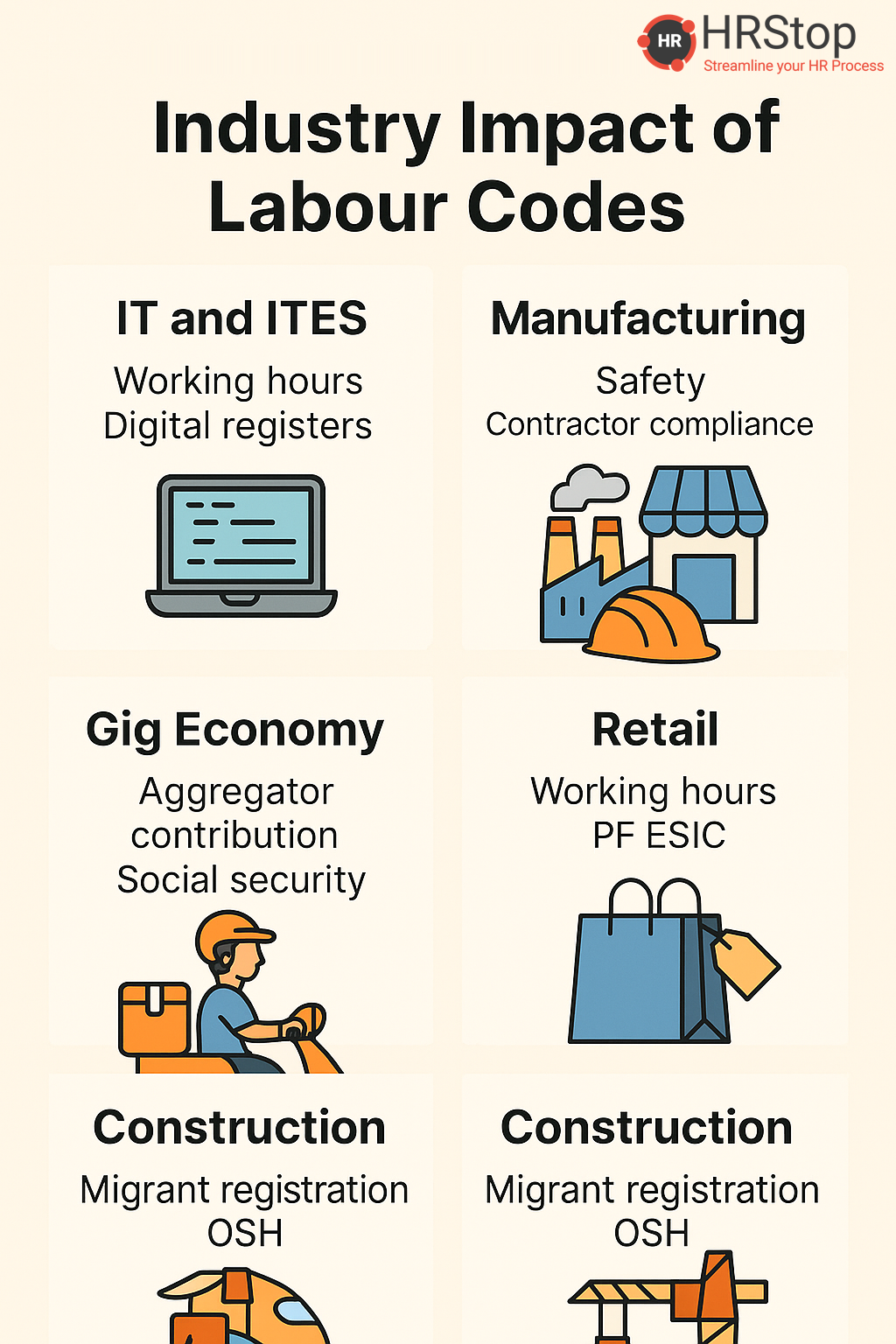
1. Information Technology and IT Enabled Services
Key impacts include:
- Structured working hour limits
- Mandatory digital registers and attendance
- Safety and consent rules for women working at night
- Increased clarity in wage structure
- Digital inspections applicable
For details on working hours see Working Hours Leave and Overtime Rules.
2. MSMEs and Startups
MSMEs benefit from:
- Simplified single registration
- Digital compliance replacing manual paperwork
- Wider PF and ESIC applicability
- More predictable inspections
Startups must strengthen documentation due to wage definition requirements and appointment letter rules.
3. Manufacturing and Heavy Industries
Major impacts include:
- Mandatory safety standards under OSH
- Stricter contractor compliance
- Digital attendance and wage records
- Uniform working hours
- Migrant worker documentation
See Occupational Safety and Health Code Explained.
4. Gig and Platform Economy
Gig workers now receive:
- Social security coverage
- Aggregator contribution requirements
- Digital worker identity and tracking
- Defined entitlement framework
For more on gig worker coverage read Gig and Platform Workers Social Security.
5. Retail and E commerce
Key impacts include:
- Digital registers replacing state wise formats
- Uniform working hours
- Women night shift rules
- Wider PF and ESIC coverage for frontline staff
6. Logistics and Warehousing
Changes include:
- Digital contractor documentation
- Mandatory attendance and wage records
- Safety norms for loading and handling
- Increased inspection readiness
7. Export Manufacturing and SEZs
SEZ units experience:
- Unified wage structure
- Digital compliance
- Standardised safety requirements
- Stricter contractor oversight
8. Construction Sector
Construction businesses must adopt:
- Digital migrant worker registration
- Safety and welfare norms under OSH
- Contractor accountability
- PF and ESIC compliance
See related article Inter State Migrant Worker Provisions.
Industry Impact Summary
| Industry | High Impact Areas | Key Implementation Needs |
|---|---|---|
| IT and ITES | Working hours, digital inspections | Digital registers, night shift compliance |
| MSMEs | PF and ESIC thresholds, documentation | Single registration, digital systems |
| Manufacturing | OSH compliance, contractor management | Safety audits, digital attendance |
| Gig Economy | Social security, aggregator contributions | Worker registration, payment logs |
| Retail | Working hours, digital returns | PF ESIC coverage, shift compliance |
| E commerce | Contractor oversight, worker safety | Digital documentation, uniform wages |
| Warehousing | Safety norms, contractor liability | Attendance systems, OSH adherence |
| Construction | Migrant worker records, safety | Digital registers, welfare provisions |
| Export Units | Standardised wages, digital inspections | Compliance dashboards |
HR Checklist for Immediate Action for Industry Impact Compliance
- Identify high impact areas for your specific sector
- Update wage structure to match Code definition
- Digitalise all registers and records
- Strengthen contractor and gig worker documentation
- Assess safety norms required for your risk category
- Review night shift rules and consent requirements
- Train HR teams on industry specific Code changes
Explore HRStop Today
HRStop supports industry wise compliance with digital registers, contractor modules, multi location dashboards, gig worker documentation tools, social security tracking, and inspection readiness features.
How HRStop Helps
- Digital registers aligned with Labour Codes
- Contractor and gig workforce management
- PF ESIC and wage structure integrations
- Safety and compliance documentation storage
- Multi sector compliance monitoring
- Automated inspection readiness alerts
Related Articles
- Gig and Platform Workers Social Security
- Working Hours Leave and Overtime Rules
- Updated Contract Labour Rules
- Inter State Migrant Worker Provisions
- India’s New Labour Codes 2025 Overview
Conclusion
The Labour Codes 2025 impact each industry differently based on operational structure and workforce composition. HR teams must align policies with industry specific requirements, strengthen digital documentation, and ensure safety, wage, and social security compliance across all worker categories.
FAQs
Which industry sees the highest impact?
Manufacturing, construction, logistics, and gig economy face the most significant operational shifts.
Do all industries need digital registers?
Yes, digital documentation is mandatory.
Are working hours the same across sectors?
Yes, except for specific notified categories.
Does PF and ESIC coverage expand?
Yes, more industries and worker categories fall under coverage.
Are contractor and gig workers fully included?
Yes, contractor oversights and gig worker social security are major focus areas.
Rashmi Agarwal
Tuesday, November 25, 2025
Share post:
Become part of our team
- Full Stack Developer
- Business Development Executive
- Technical Content Writer
- HR Business Partner
- Customer Happiness Executive
- Marketing Executive
One stop solution for all
Hire to Retire needs
HRStop is a complete Hire to Retire HR platform that accelerates the success of your business processes.