
Gig and Platform Workers Social Security
The Social Security Code extends formal protection to gig and platform workers for the first time in India ensuring that digital economy workers receive welfare coverage through a structured contribution system. It provides a framework for aggregator contributions Government funded benefits and national registration enabling social security access to millions of independent digital workers. This article explains the Code in detail to help HR teams and digital platforms prepare for Labour Codes 2025.
Introduction
Gig and platform workers form a significant part of the modern workforce especially in India’s rapidly growing digital and service economy. These include app based drivers delivery partners online service providers and freelance service workers who operate on a task based or platform mediated model. Earlier these workers largely remained outside traditional social security frameworks since they were neither formal employees nor fully independent contractors under labour law.
The Social Security Code redefines this landscape by providing dedicated social security schemes for gig and platform workers through a tripartite contribution system involving aggregators Central Government and State Governments. This structure increases financial protection for workers while ensuring clarity and predictability for digital platforms. The Code also sets up national registration systems social security funds and schemes such as health insurance disability support accident benefits and old age protection.
Key Changes at a Glance
- New legal definitions for gig workers and platform workers
- Aggregator contribution system for social security funds
- National database and mandatory registration
- Government notified schemes for health social insurance and old age protection
- Coverage for accident disability and maternity benefits (based on scheme)
- No employer employee relationship required for benefits
- Flexible contribution structure suitable for platform based work
- Protection for multiple platform workers under one system
- Use of digital compliance and online record systems
Detailed Explanation of Gig and Platform Worker Social Security
The points below summarise the key components of the Social Security Code that directly impact gig workers platform workers and digital aggregators.
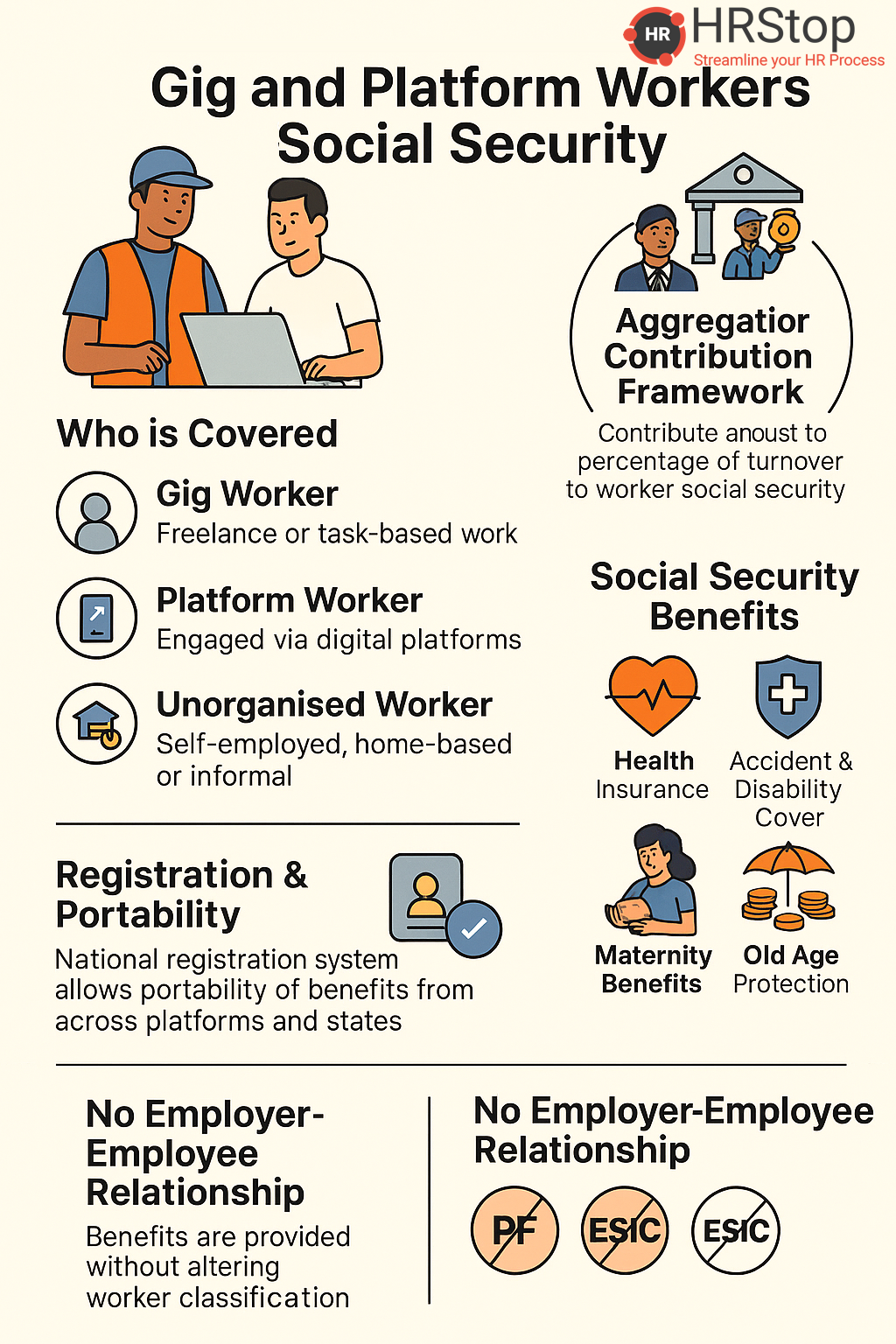
1. Legal Definitions and Worker Categories
The Code clearly distinguishes between worker groups.
- Gig Worker
A person who performs work outside of traditional employment relationships such as freelance or task based services. - Platform Worker
A worker engaged by a digital platform or online aggregator to provide services such as delivery driving or on demand tasks. - Unorganised Worker
Self employed or home based workers outside formal employment structures.
A detailed comparison is included later in this article to help HR teams and platforms understand coverage obligations.
2. Aggregator Contribution Framework
Aggregators are required to contribute a percentage of their annual turnover towards the social security fund for gig and platform workers. The exact percentage will be notified by the Government.
Aggregators include services such as:
- Ride hailing platforms
- Food delivery apps
- E commerce and logistics platforms
- Professional service marketplaces
- Home service applications
The contribution framework provides a predictable structure for supporting worker social security without creating a direct employer employee relationship.
3. Social Security Schemes for Gig Workers
Central and State Governments will notify specific schemes covering:
- Health and maternity benefits
- Accident and disability insurance
- Life and term insurance
- Old age protection
- Skill development and training support
This ensures that workers in the digital economy receive similar protections that organised sector employees enjoy under PF ESIC and other schemes. For broader coverage details you may also read Social Security Code Explained.
4. Registration System for Workers and Aggregators
Gig workers platform workers and unorganised workers must register on the designated portal using Aadhaar based authentication. Aggregators also must register their organisations and worker lists digitally.
This helps build a national database enabling portability of benefits across platforms and States.
5. Benefit Portability Across Platforms
Workers who serve multiple platforms will enjoy combined benefits through a unified system. Contributions made by different aggregators accumulate under the worker’s unique registration ID.
This model supports workers who perform work through multiple apps.
6. No Employer Employee Relationship Required
A unique feature of the Code is that gig and platform workers receive social security without being classified as employees.
This means:
- No PF
- No ESIC
- No gratuity
- No wage obligations
Instead they receive benefits through separate schemes funded by aggregators and Governments.
This helps avoid legal ambiguity while still ensuring welfare coverage.
7. Eligibility Conditions for Specific Schemes
Each scheme will define eligibility based on:
- Minimum number of working hours
- Minimum number of tasks
- Annual income from platform work
- Registration status
- Verified identity
This ensures that benefits reach active and genuine workers.
8. Penalties for Non Compliance by Aggregators
Aggregators failing to contribute required amounts may face penalties including fines or recovery orders. The exact procedures will be defined by the Central Government.
9. Impact for Employers and Digital Platforms
Platforms must:
- Calculate contributions based on notified turnover percentage
- Maintain updated worker databases
- Coordinate with Government portals
- Manage periodic reporting
- Educate workers on registration
- Maintain digital compliance documentation
This ensures transparent protection for gig and platform workers.
Gig Workers vs Platform Workers vs Unorganised Workers vs Employees
| Category | How They Work | Who Pays Contribution | Type of Benefits | Employment Relationship | Included in Which Codes |
|---|---|---|---|---|---|
| Gig Worker | Task based non platform work | Government plus worker plus aggregator (scheme specific) | Accident insurance social insurance old age support | No employer employee relationship | Social Security Code |
| Platform Worker | Works through digital apps providing on demand services | Aggregator plus Government | Health maternity accident disability old age schemes | No employer employee relationship | Social Security Code |
| Unorganised Worker | Self employed home based or informal work | Government funded schemes | Health insurance life cover pension schemes | No employer employee relationship | Social Security Code |
| Employee | Works under contract of employment | Employer plus employee contributions | PF ESIC gratuity maternity benefits | Yes employer employee relationship | All Labour Codes |
This table helps HR teams platforms and policymakers distinguish between worker categories and their entitlement structures.
HR Checklist for Immediate Action for Gig and Platform Worker Social Security Compliance
- Register all gig and platform workers on the central portal
- Maintain updated worker lists with Aadhaar based verification
- Calculate aggregator contributions based on applicable turnover percentage
- Communicate registration steps clearly to all workers
- Implement internal systems for periodic reporting
- Prepare digital compliance documents for inspections
- Monitor Government notifications for scheme specific requirements
- Review agreements with workers to ensure clarity on benefits
Explore HRStop Today
HRStop supports compliance with gig and platform worker social security by providing digital registration modules contribution tracking document management and automated reminders. It simplifies compliance for aggregators and ensures workers are properly registered under the new framework.
How HRStop Helps
- Digital worker registration support
- Contribution calculation tracking
- Access controlled worker records
- Automated compliance reminders
- Document upload and verification workflows
- Unified dashboard for all worker categories
Related Articles
- Social Security Code Explained
- EPF and ESIC Changes Under New Codes
- Inter State Migrant Worker Provisions
- Sector Wise Comparison Table Under New Labour Codes
- Impact of Labour Codes on Key Industries
- India’s New Labour Codes 2025 Overview
Conclusion
The Social Security Code marks a historic shift by extending welfare coverage to gig and platform workers creating a support system suitable for India’s evolving digital economy. With structured contributions Government backed schemes and centralised worker registration the Code strengthens protection for millions of workers outside traditional employment. HR teams aggregators and digital platforms must adopt digital systems update contribution workflows and educate workers to ensure full compliance as Labour Codes 2025 become operational.
FAQs
Are gig and platform workers covered under PF and ESIC
No PF and ESIC apply only to traditional employees. Gig workers receive separate scheme based benefits.
Do aggregators need to contribute every month
Contributions are based on annual turnover and timelines will be notified in rules.
Can workers registered on multiple platforms receive combined benefits
Yes benefits are portable across platforms.
Is registration mandatory for receiving benefits
Yes workers must register on the designated central portal.
Do unorganised workers receive similar benefits
Yes but benefits depend on specific government funded schemes.
Does the Code create an employer employee relationship
No it provides social security without altering employment classification.
Rashmi Agarwal
Tuesday, November 25, 2025
Share post:
Become part of our team
- Full Stack Developer
- Business Development Executive
- Technical Content Writer
- HR Business Partner
- Customer Happiness Executive
- Marketing Executive
One stop solution for all
Hire to Retire needs
HRStop is a complete Hire to Retire HR platform that accelerates the success of your business processes.