
Appointment Letter Requirements
The Labour Codes 2025 make appointment letters mandatory for all employees, including fixed term, permanent, contract, and gig workers (where applicable). Each appointment letter must include specific details on wages, classification, working hours, benefits, and conditions of employment. This article explains the mandatory components and what HR teams must update.
Introduction
Under earlier labour laws, appointment letters were not uniformly mandatory across sectors, often resulting in unclear employment terms and disputes. The new Labour Codes 2025 introduce a single national requirement ensuring that every employee receives a formal appointment letter on or before joining.
The Code standardises the content of appointment letters, defines what must be included, and requires clear documentation of wages, leave rules, classification, and other employment conditions. This improves transparency, protects employee rights, and ensures smoother audits and inspections for employers.
This article outlines the required components and guides HR teams in updating their templates and onboarding processes.
Key Changes at a Glance
- Appointment letters mandatory for all employees
- Standardised components across all sectors
- Includes classification, wage structure, and benefits
- Must specify working hours, leave rules, and conditions
- Applies to fixed term employees as well
- Supports digital onboarding and recordkeeping
- Mandatory before or on the date of joining
Detailed Explanation of Appointment Letter Requirements
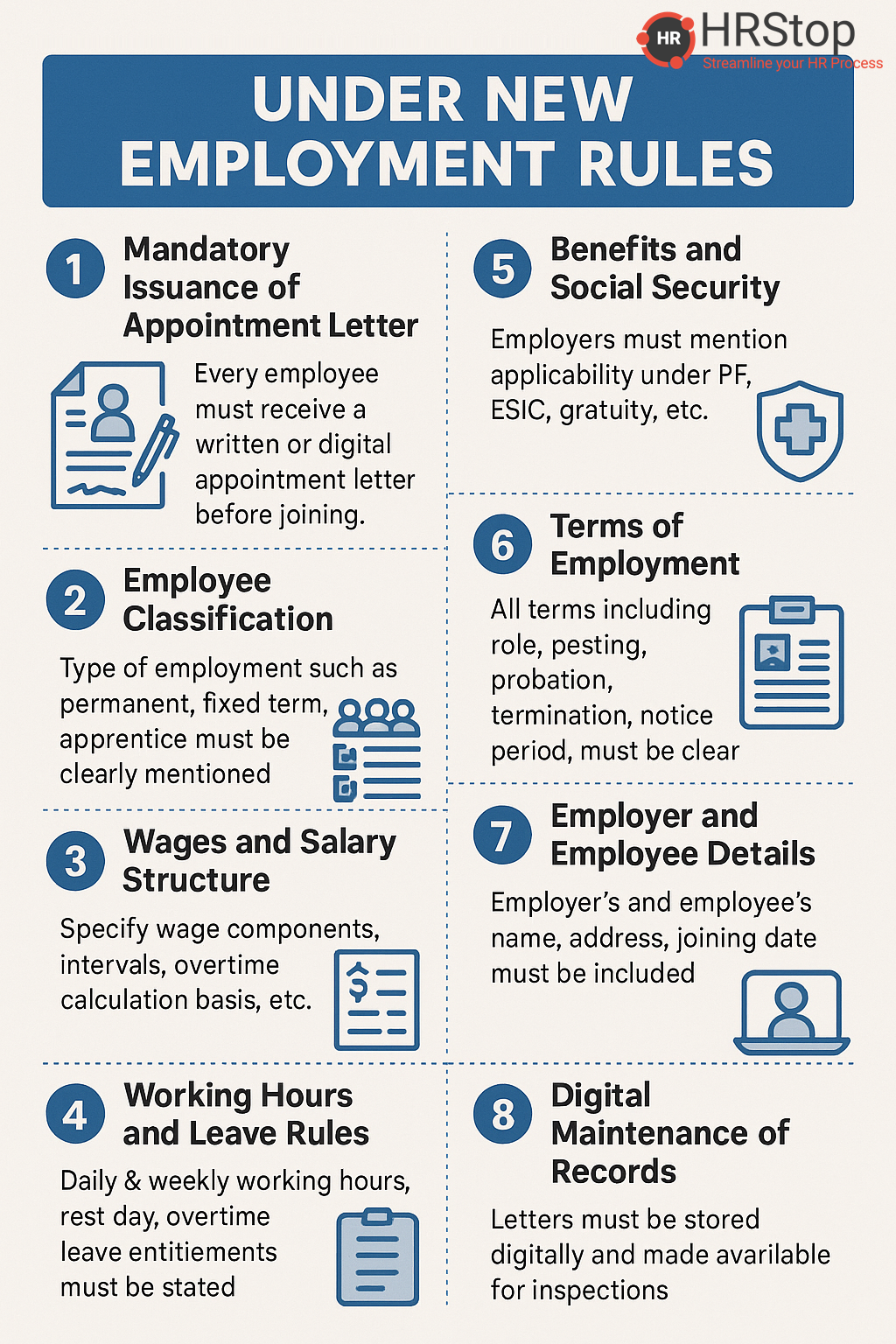
1. Mandatory Issuance of Appointment Letter
Every employee must receive a written or digital appointment letter before joining.
This applies to:
- Permanent employees
- Fixed term employees
- Contract workers
- Apprentices
- Trainees
For fixed term specifics read Fixed Term Employment Rules.
2. Employee Classification
The appointment letter must clearly mention the type of employment such as:
- Permanent
- Fixed term
- Temporary
- Apprentice
- Trainee
This prevents disputes on status and benefits.
3. Wages and Salary Structure
The letter must specify:
- Detailed wage components
- Basic wage
- Allowances
- Bonuses if applicable
- Payment intervals
- Overtime calculation basis
For wage structure details refer to New Wage Structure and the Fifty Percent Rule.
4. Working Hours and Leave Rules
The appointment letter must state:
- Daily and weekly working hours
- Weekly rest day
- Overtime rules
- Leave entitlements
For linked rules read Working Hours Leave and Overtime Rules.
5. Benefits and Social Security
Employers must mention eligibility and coverage under:
- PF
- ESIC
- Gratuity
- Maternity benefits
- Other applicable schemes
See EPF and ESIC Changes Under New Codes for details.
6. Terms of Employment
This includes:
- Job role and responsibilities
- Place of posting
- Transferability
- Probation period
- Confirmation conditions
- Termination rules
- Notice period
All terms must be clearly stated to avoid ambiguity.
7. Employer and Employee Details
The letter must include:
- Employer name and address
- Employee name and ID
- Department
- Date of joining
- Signature or digital consent
8. Digital Maintenance of Records
Appointment letters must be stored digitally and made available for inspections under the digital compliance framework.
For more on digital recordkeeping see Digital Compliance and Online Records.
Appointment Letter Provisions
| Category | Earlier Practices | New Provisions Under Labour Codes 2025 |
|---|---|---|
| Mandatory Issuance | Not universal | Mandatory for all employees |
| Content Requirements | Varied | Standardised across sectors |
| Working Hours Details | Not always included | Mandatory to specify |
| Wages Breakdown | Often unclear | Must have detailed wage structure |
| Benefits Information | Inconsistent | PF ESIC gratuity details required |
| Digital Storage | Optional | Mandatory digital storage |
| Fixed Term Employees | Mostly excluded | Fully covered |
HR Checklist for Immediate Action for Appointment Letter Compliance
- Update appointment letter templates
- Include all mandatory components
- Set up digital issuance and storage
- Ensure wage structure matches new definition
- Align leave and working hour details with Codes
- Cover benefits and social security elements
- Train onboarding teams on new requirements
Explore HRStop Today
HRStop automates appointment letter generation with pre-configured templates, digital issuance, e-sign workflows, and compliant recordkeeping aligned with Labour Codes 2025.
How HRStop Helps
- Customisable appointment letter templates
- Digital signing and issuance
- Wage structure auto-mapped from payroll
- PF ESIC and gratuity integrations
- Secure cloud storage and audit logs
- Onboarding compliance checklists
Related Articles
- Fixed Term Employment Rules
- Working Hours Leave and Overtime Rules
- EPF and ESIC Changes Under New Codes
- Digital Compliance and Online Records
- India’s New Labour Codes 2025 Overview
Conclusion
Appointment letters under Labour Codes 2025 are mandatory, detailed, and crucial for transparent employment practices. They protect both employees and organisations by ensuring clarity in wages, working hours, benefits, and conditions of service. HR teams must update templates and automate issuance to stay fully compliant.
FAQs
Are appointment letters mandatory for all employees?
Yes, for all categories including fixed term workers.
Should wage structure details be included?
Yes, detailed breakdown is mandatory.
Can appointment letters be digital?
Yes, digital issuance and storage are permitted and encouraged.
Do contractors need appointment letters for their workers?
Yes, contractors must issue letters and employers must verify compliance.
Are probation and notice periods required in the letter?
Yes, all terms must be clearly stated.
Rashmi Agarwal
Tuesday, November 25, 2025
Share post:
Become part of our team
- Full Stack Developer
- Business Development Executive
- Technical Content Writer
- HR Business Partner
- Customer Happiness Executive
- Marketing Executive
One stop solution for all
Hire to Retire needs
HRStop is a complete Hire to Retire HR platform that accelerates the success of your business processes.