
Social Security Code Explained
The Social Security Code consolidates nine major welfare laws into a unified structure to strengthen employee benefits ensure universal coverage and streamline employer compliance. It introduces new entitlements for gig workers platform workers unorganised workers and fixed term employees while modernising PF ESIC gratuity maternity and dependent benefits. This article provides a comprehensive explanation to help HR teams prepare for Labour Codes 2025 with clarity and confidence.
Introduction
The Social Security Code is one of the most extensive reforms under the Labour Codes 2025 because it directly affects wage linked benefits that employees use throughout their employment lifecycle. By unifying multiple social security laws the Code creates a predictable and efficient framework for employers while expanding coverage for workers who were previously excluded such as gig workers unorganised workers fixed term employees and inter state migrant workers.
This Code modernises the administration of PF ESIC maternity benefits gratuity creche facilities and dependent benefits. It also expands the definition of “employee” and introduces digital systems for registration contributions and inspections. HR teams must understand each component in depth because the Code influences payroll structures financial planning and long term employee well being.
Key Changes at a Glance
- Nine laws combined into one consolidated Social Security Code
- Uniform benefit rules for PF ESIC gratuity and maternity benefits
- Social security extended to gig workers platform workers and unorganised workers
- Gratuity eligibility simplified for Fixed Term Employees
- ESIC expanded to cover all districts across India
- Creche facilities required for establishments with fifty or more employees
- Digital records registrations and inspections for compliance transparency
- Employer and aggregator contributions defined clearly
Detailed Explanation of the Social Security Code
The points below break down each major provision of the Social Security Code so HR teams can understand how benefits apply to different categories of workers and how employers must prepare.
1. Provident Fund (PF) Framework
The PF framework continues to follow the pattern of contribution based retirement savings for employees. Establishments with twenty or more workers are required to contribute. PF applies to all employees including Fixed Term Employees since their benefit entitlements are equal to permanent staff.
Important updates include standardisation of wage definition which also impacts the PF wage base. To understand the wage definition and structure you may read New Wage Structure and the Fifty Percent Rule.
2. Employee State Insurance (ESIC) Expansion
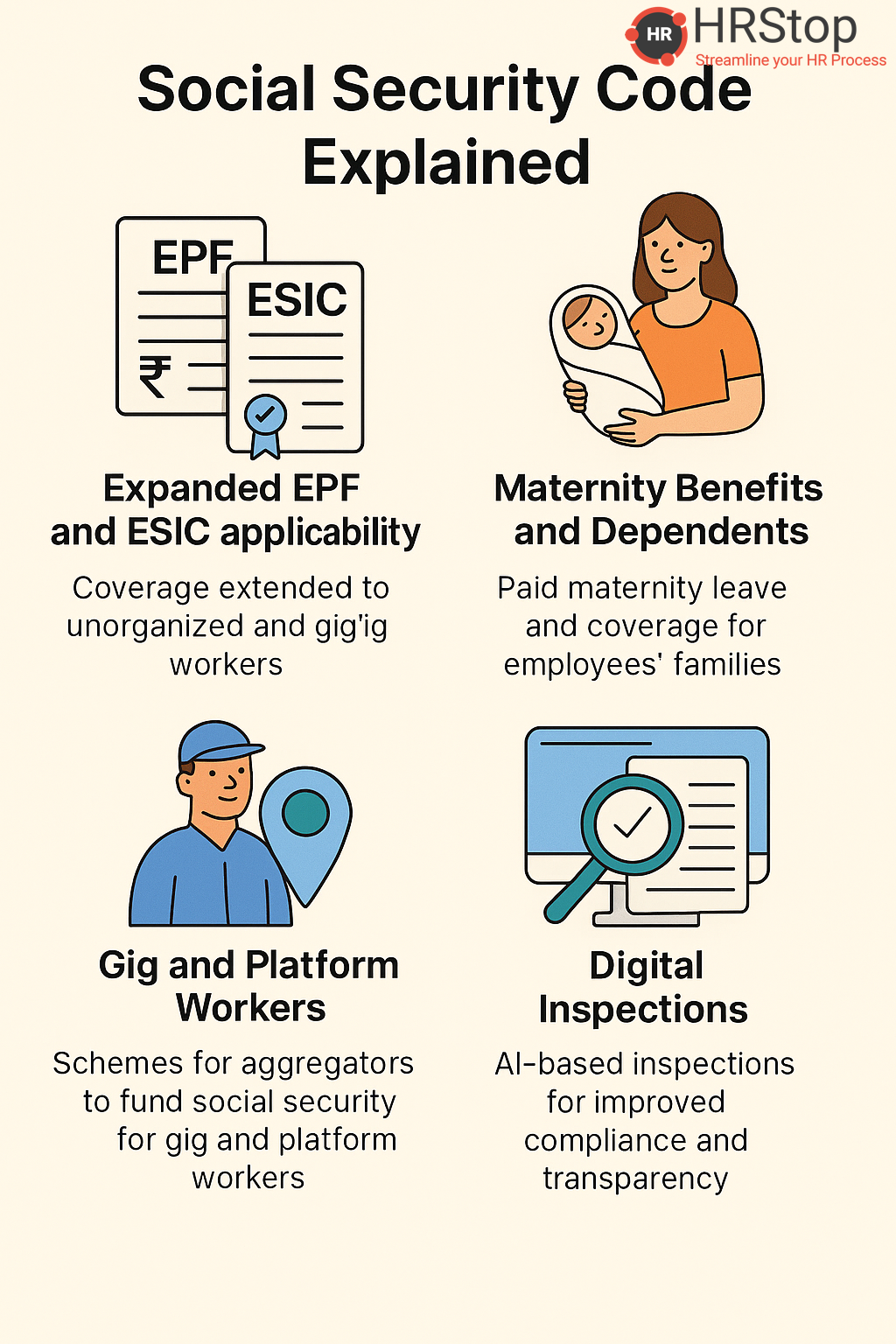
ESIC coverage is expanded across every district in India. Any establishment with ten or more employees (or threshold defined by state) must register for ESIC. Coverage now includes gig workers unorganised workers and platform workers once specific schemes are notified.
The Social Security Code merges earlier provisions and provides insured workers access to medical care sickness benefits maternity benefits disablement benefits and dependents benefits. For related updates you may also read EPF and ESIC Changes Under New Codes.
3. Maternity Benefits
Maternity benefits continue with robust protections. Eligible women receive twenty six weeks of paid maternity leave maternity bonus and nursing breaks. The Code maintains the requirement for employers to provide creche facilities if they have fifty or more employees.
This strengthens workplace inclusion and supports working mothers with essential childcare support.
4. Gratuity for Fixed Term Employees
Fixed Term Employees are now eligible for gratuity after completing one year of continuous service which is a major shift from the five year rule for permanent employees. This expands social security coverage for project based workers.
To learn more about FTE rules refer to Fixed Term Employment Rules.
5. Gig and Platform Worker Social Security
One of the most significant reforms is the introduction of social security schemes for gig and platform workers such as delivery partners drivers online service providers and app based workers. The Code defines aggregators like ride hailing apps food delivery services and e commerce platforms.
Aggregators are required to make defined contributions toward the social security of gig workers. For an in depth view read Gig and Platform Workers Social Security.
6. Unorganised Workers Coverage
Unorganised workers including self employed workers domestic help and home based workers are brought under the Social Security Code. A national database will be created for their registration and benefits will apply through government funded schemes.
This expands the reach of social protection to millions of workers.
7. Inter State Migrant Worker Benefits
Inter state migrant workers receive portability of welfare schemes allowing seamless access to benefits while moving between states. They also receive travel allowance and registration support. To understand migrant worker rights you may read Inter State Migrant Worker Provisions.
8. Creche Facilities and Childcare Entitlements
Establishments with fifty or more employees must provide creche facilities. This requirement helps working parents especially mothers maintain workforce participation while ensuring proper child care support.
9. Dependents Benefits and Disability Coverage
Dependents of insured employees receive financial support in case of death due to employment injury. Disability benefits and pension schemes for invalidity and partial permanent disability continue under the unified framework.
This ensures long term financial security for families of workers.
10. Social Security Boards and Scheme Administration
The Code mandates the formation of national and state social security boards to monitor implementation. These bodies will ensure uniformity in benefits and effective administration.
11. Digital Records and Compliance Systems
Digital registration contributions and inspections are core components of the Social Security Code. Employers must maintain electronic records of contributions wages and employment status. Inspections are algorithm based and designed to reduce harassment while improving compliance transparency.
For additional details on digital compliance you may read Digital Inspections Under New Labour Codes.
HR Checklist for Immediate Action for Social Security Code Compliance
- Review PF and ESIC applicability based on new definitions and coverage
- Register eligible FTE gig and platform workers under applicable schemes
- Prepare creche facility arrangements for establishments with fifty or more employees
- Maintain accurate and updated digital employee records
- Review eligibility for maternity benefits and ensure compliant policies
- Verify gratuity eligibility for FTE workers completing one year
- Update appointment letters to include social security benefits
- Configure payroll contributions to align with new wage definition
- Train HR teams and managers on extended social security coverage
Explore HRStop Today
HRStop helps organisations stay compliant with the Social Security Code by automating registrations updating statutory benefits generating digital records and ensuring accurate PF ESIC and maternity compliance. With HRStop HR teams can manage social security obligations with ease and adapt smoothly to Labour Codes 2025.
How HRStop Helps
- Automated PF and ESIC contribution calculations
- Digital employee records and statutory registers
- Support for gig worker and FTE benefit documentation
- Maternity and creche compliance workflows
- Alerts for statutory deadlines and benefit eligibility
- Unified dashboard for managing all categories of workers
Related Articles
- Gig and Platform Workers Social Security
- EPF and ESIC Changes Under New Codes
- Inter State Migrant Worker Provisions
- Sector Wise Comparison Table Under New Labour Codes
- Impact of Labour Codes on Key Industries
- India’s New Labour Codes 2025 Overview
Conclusion
The Social Security Code significantly expands the protective framework for workers while simplifying compliance for employers. By unifying major welfare laws and extending coverage to gig workers unorganised workers and Fixed Term Employees the Code builds an inclusive social security system suited for a modern workforce. HR teams must carefully implement these changes by updating payroll structures benefit policies documentation and digital records. With proper preparation organisations can transition smoothly to the Labour Codes 2025 and provide meaningful well being support for their workforce.
FAQs
Does the Social Security Code replace multiple earlier laws
Yes it consolidates nine major laws including EPF ESIC Maternity Benefit and Payment of Gratuity.
Are gig and platform workers covered
Yes they receive social security through aggregator contributions and government schemes.
Is gratuity payable to Fixed Term Employees
Yes they are eligible after one year of continuous service.
Does ESIC now apply across India
Yes ESIC coverage extends to all districts.
Are creche facilities mandatory
Yes for establishments with fifty or more employees.
Do unorganised workers receive benefits
Yes they are included through central and state government schemes.
Are digital records required
Yes digital registration documentation and inspections are key compliance requirements.
Rashmi Agarwal
Tuesday, November 25, 2025
Share post:
Become part of our team
- Full Stack Developer
- Business Development Executive
- Technical Content Writer
- HR Business Partner
- Customer Happiness Executive
- Marketing Executive
One stop solution for all
Hire to Retire needs
HRStop is a complete Hire to Retire HR platform that accelerates the success of your business processes.